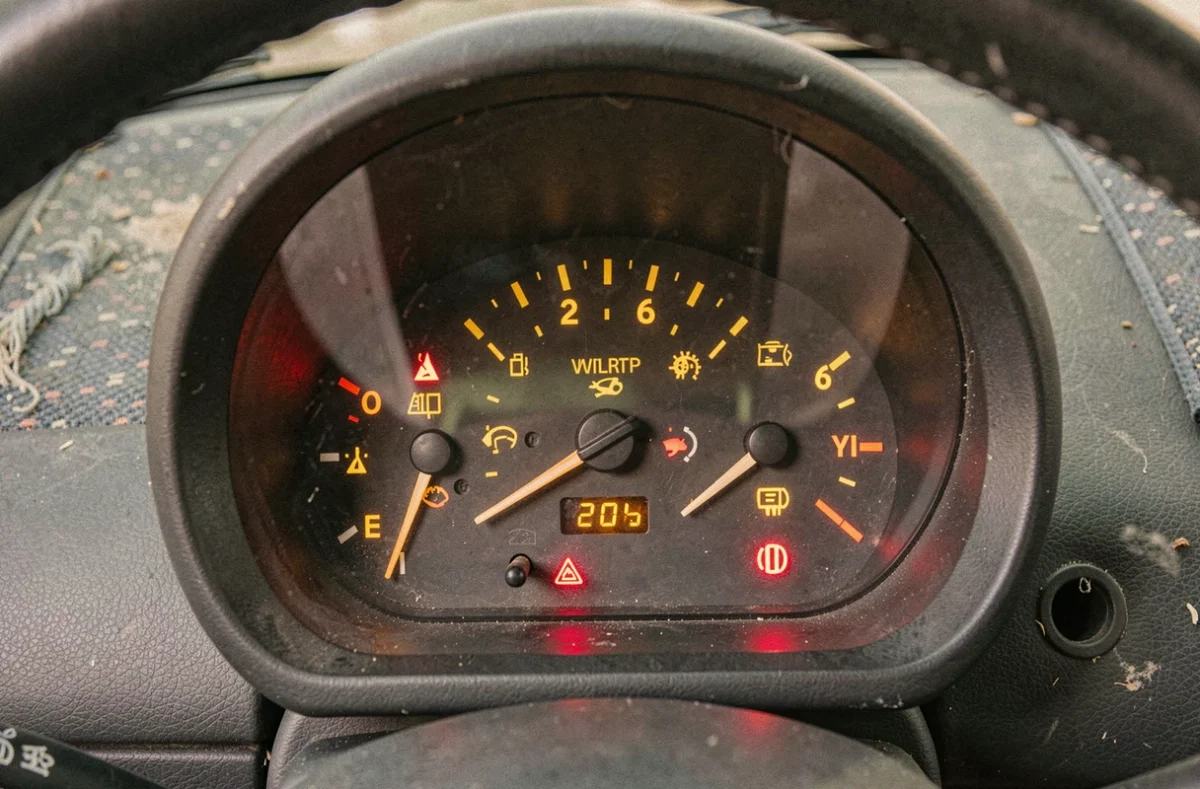
The dashboard of the Peugeot 206 features around twenty warning lights, the meaning of which varies according to color, blinking, and the context in which they appear. Produced in over eight million units, this city car remains very present on French roads, and its indicators continue to puzzle owners, sometimes long after the owner’s manual has disappeared from the glove compartment.
Intermittent faults on Peugeot 206: why a light that goes off does not mean the fault is resolved
A light that disappears after a restart gives a false sense of security. The 206’s computer records anomalies in its internal memory, even when the warning light is no longer displayed on the dashboard. An intermittent fault can reappear without warning, sometimes under driving conditions different from those in which it first manifested.
The best practice is to note the exact circumstances of the light activation: vehicle speed, outside temperature, gear engaged, duration since starting. These details guide the diagnosis during memory reading. An OBD reader connected to the diagnostic port allows retrieval of stored fault codes, including those that no longer activate a visible light.
Ignoring an intermittent fault in the cooling system or braking system exposes one to rapid deterioration. For example, engine oil pressure may briefly drop at low RPM and then return to normal during acceleration, without the driver perceiving anything other than a brief blink of the red warning light.
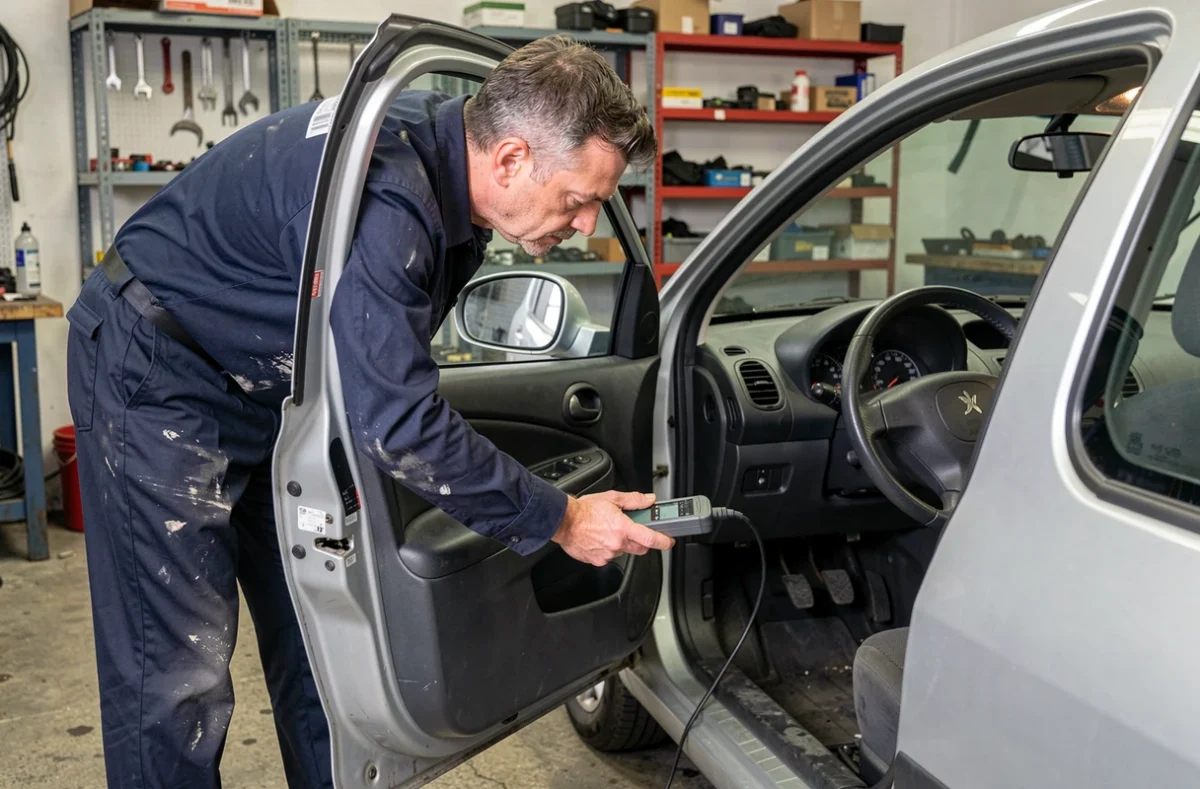
Understanding the list of warning lights on Peugeot 206 requires distinguishing between one-time alerts and stored faults that require manual clearing after repair.
Airbag warning light on 206: the limits of standard diagnostics
The airbag light is one of the most misunderstood indicators. On the 206, it can illuminate for a driver’s airbag fault, seatbelt pretensioner, side sensor, power supply issue, or simple connectivity problem. A generic OBD reader does not always communicate with the SRS computer, making the diagnosis incomplete if the tool used is not compatible with this safety system.
The connectors located under the front seats are a recurring cause of this light illuminating on older vehicles. A seat adjustment, cabin cleaning, or work on the mounting rails can create a false contact. The temptation to check these connections oneself is met with a safety constraint: pyrotechnic elements (airbags, pretensioners) must not be disconnected or measured without specific precautions.
Using a diagnostic tool dedicated to the airbag computer remains the only reliable method to identify the faulty line. The error code points to the specific component, avoiding blind replacement of expensive parts.
Color code of dashboard warning lights: what the level of urgency changes concretely
The color logic of the 206’s dashboard follows a simple principle but is often overlooked in practice.
- Red lights require the vehicle to stop as soon as possible. They concern oil pressure, coolant temperature, brake fluid level, engaged handbrake, or the centralized STOP light that groups several critical alerts.
- Orange lights indicate a malfunction detected by the onboard electronics (injection, pollution control, ABS, ESP) that does not immediately endanger the engine but degrades the vehicle’s operation or emissions.
- Green and blue lights are indicators of normal operation: low beams, high beams, turn signals. They do not require any action as long as they correspond to a command activated by the driver.
The STOP light centralizes several simultaneous red alerts. When it lights up alone, without any associated light, a sensor or connectivity issue is likely. When it accompanies another red light, priority is given to the system concerned by this second indicator.
Orange engine light on 206 HDi: injection and pollution control
On HDi diesel engines, the orange engine light (often represented by an engine block icon) indicates a fault detected by the electronic management system. Causes range from a simple clogged air temperature sensor to a more serious anomaly in the turbo pressure regulation solenoid.
Switching to limp mode limits the power and speed of the vehicle to protect the engine. This behavior is intentional and programmed by the computer. Forcing driving under these conditions accelerates the wear of the affected components.

Manufacturer recall and persistent light: check by VIN number
A light that persists despite successive repairs may, in some cases, be related to an unperformed safety recall. The verification must go through the vehicle’s VIN number, not through a search by model or year. Each recall targets specific ranges of serial numbers, and two 206s from the same year may not be affected by the same notice.
Recalls on airbag computers, particularly those related to Takata inflators, have affected a large number of vehicles across all brands. Checking for an ongoing recall before any repair prevents paying for a diagnosis for a problem whose correction is covered by the manufacturer.
Official manufacturer websites and some specialized platforms allow this free verification using the VIN engraved on the manufacturer’s plate or visible at the bottom of the driver’s side windshield.
On a vehicle as widespread as the 206, the temptation to postpone a diagnosis until the next technical inspection remains strong. A warning light illuminated on the dashboard is not decoration. Even when it seems trivial, it signals a discrepancy between the expected operation and the actual operation of the vehicle, and this discrepancy will always end up translating into a bill or a breakdown.