
After a death, condolence messages arrive by the dozens. Letters, SMS, social media posts, emails: every word received carries sincere attention. These messages form a precious collection, but their volume and dispersion across multiple platforms make their preservation difficult. Gathering them in a readable and durable format allows for revisiting them without anxiety, months or years later.
Gathering condolence messages before they disappear
The first useful reflex is to identify all the channels through which the messages arrived. A condolence SMS can coexist with a voice message on WhatsApp, a comment under a Facebook post, and a postcard slipped into the mailbox.
Each medium has its fragility. A changed phone erases SMS. A deactivated social media account takes away comments. A paper card stored in a drawer can end up dog-eared or lost during a move.
- SMS and instant messages (WhatsApp, Messenger) can be exported as text or PDF files from the settings of each application, conversation by conversation.
- Posts and comments on social media can be captured by manual copying or screenshot, as export functions do not always include them.
- Letters and paper cards benefit from being digitized with a simple smartphone, ensuring to photograph the envelope if it has handwritten notes.
- Voice messages can be saved as audio files and then stored in a dedicated folder on a computer or an online storage service.
Acting in the weeks following the death reduces the risk of accidental loss. If this task seems too overwhelming immediately, asking a trusted friend to take care of it is a reasonable option.
Writing a personalized condolence thank-you card also helps keep a record of one’s own response to these tributes, which naturally complements the archive being created.

Post-mortem directives and legal framework for digital messages
You may be wondering if you have the right to keep messages sent by others to the deceased. French law provides a precise framework on this point.
Articles 84 to 86 of the Data Protection Act organize the regime for the data of deceased persons. Classic rights over data cease upon death, but two mechanisms extend them.
The first is that of digital advance directives. Article 85 allows any person to define, while alive, directives regarding the preservation, deletion, and communication of their personal data after death. These directives can be general (entrusted to a certified third party) or specific to a given service.
The second mechanism concerns heirs in the absence of directives. Heirs can request the closure or memorialization of an account, but they do not automatically gain full access to messaging content. The confidentiality of correspondence limits this access.
In practical terms, the condolence messages you received on your own phone or account belong to you. The legal question mainly arises for messages present on the devices or accounts of the deceased.
Transforming received messages into a soothing memory support
Once the messages are gathered, their raw form (bulk screenshots, text files) remains unpleasant to consult. The next step is to give them a form that invites re-reading without reviving the pain of mourning.
The compiled notebook, paper or digital
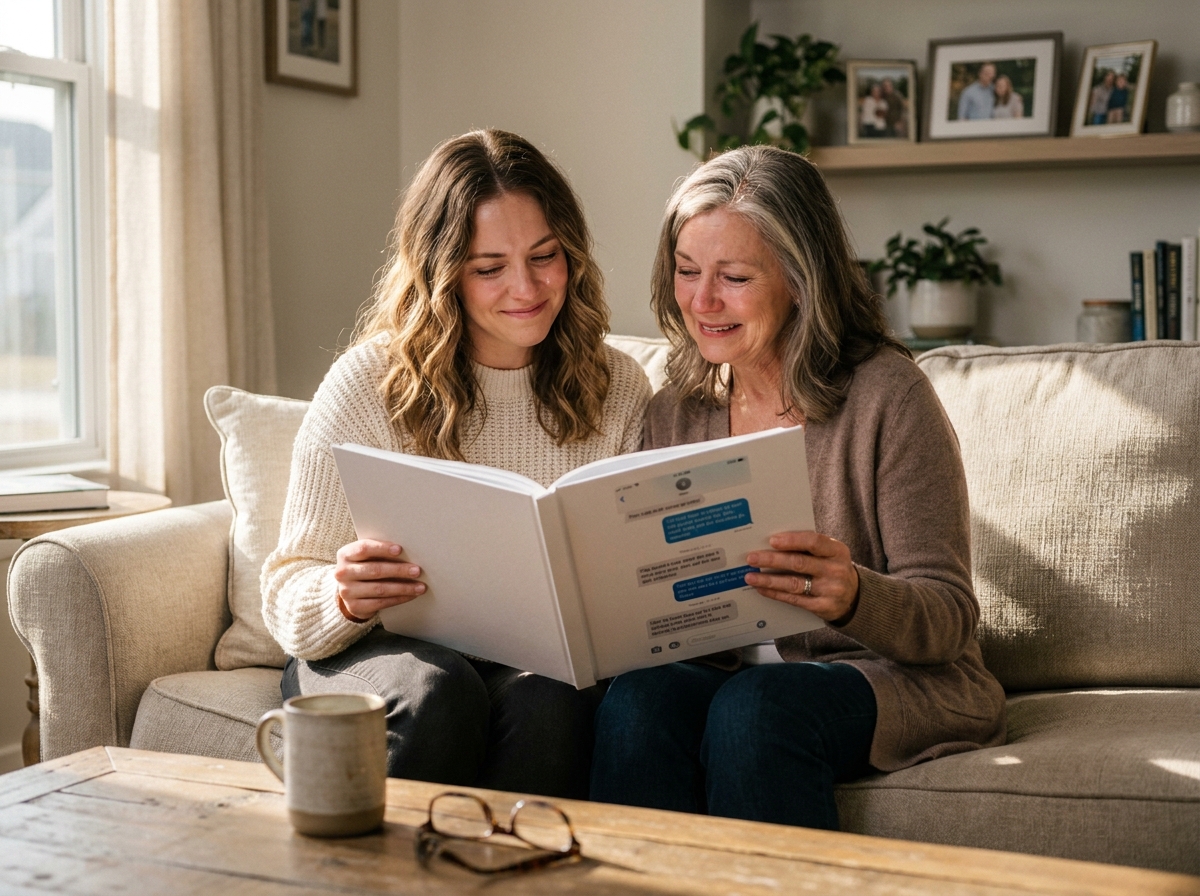
Transcribing or pasting the messages into a single document (a formatted PDF file, a printed notebook via an online printing service) transforms scattered fragments into a coherent object. Organizing the messages by author rather than by date helps easily find the words of a particular person.
Adding a short context under each message (the author’s relationship with the deceased, the circumstance of the sending) enriches the reading for other family members who will discover this collection later.
The structured digital folder
For those who prefer the digital format, a dedicated folder on an online storage service (cloud) offers two advantages: automatic backup protects against data loss, and sharing with other relatives can be done in just a few clicks.
Naming the files explicitly (“Condolence-Messages-Marie-Dupont-SMS”, “Card-Family-Martin”) makes navigation within the folder easier, even years later.
Protecting the memory without locking oneself in
Archiving condolence messages after a death only makes sense if this process remains a support and not a source of obsession. A few practical guidelines help find this balance.
Choosing a specific moment to create the archive avoids spending weeks re-reading the same texts repeatedly. Setting one or two work sessions is sufficient in most cases.
Entrusting the final review to a trusted person, a friend or a family member less directly affected by the mourning, allows for checking that nothing painful (an awkward message, a tonal error) has slipped into the collection without being flagged.
Some messages also deserve to be shared with their author. Thanking someone by telling them that their words have been preserved strengthens the bond with those around and gives a concrete meaning to the tribute received.
The work of memory evolves over time. A collection of messages re-read a year after the death does not have the same effect as the day after the funeral. Keeping the collection accessible but not prominent (in an identified drawer, in a well-named digital folder) allows for revisiting it when needed, without it imposing itself daily.
Preserving the messages received after the loss of a loved one is keeping a tangible proof that this person mattered to many people. This trace, organized with care, becomes a family memory that can be passed down, well beyond the immediate mourning.