We’ve all encountered that person in the gym who spends forty minutes doing cable obliques, convinced they are melting away their love handles. Love handles don’t disappear through localized work. They recede when overall energy expenditure increases and body composition changes. The choice of machine matters, but not for the reasons one might think.
Abdominal Fat and Gym Machines: Why Local Targeting Doesn’t Work
The fat stored above the hips is primarily subcutaneous, sometimes associated with visceral fat. No fitness machine can mobilize it in isolation. Fat loss follows a global pattern dictated by genetics, hormonal profile, and caloric deficit.
This observation changes the perspective. Instead of looking for “the” miracle machine, we select those that burn the most calories per unit of time, engage large muscle chains, and allow for intensity variation. We then discover that some effective machines against love handles are effective primarily because they create a high energy debt, not because they “work the waist.”
A program combining cardio and weight training with progressively heavier loads reduces waist circumference more than a cardio-only program. Weight training improves insulin sensitivity, a direct factor in abdominal storage. Therefore, it’s beneficial to incorporate heavy strength sessions in addition to cardio machines.
Rowing Machine and Arm Bike: The Machines to Prioritize for Caloric Expenditure
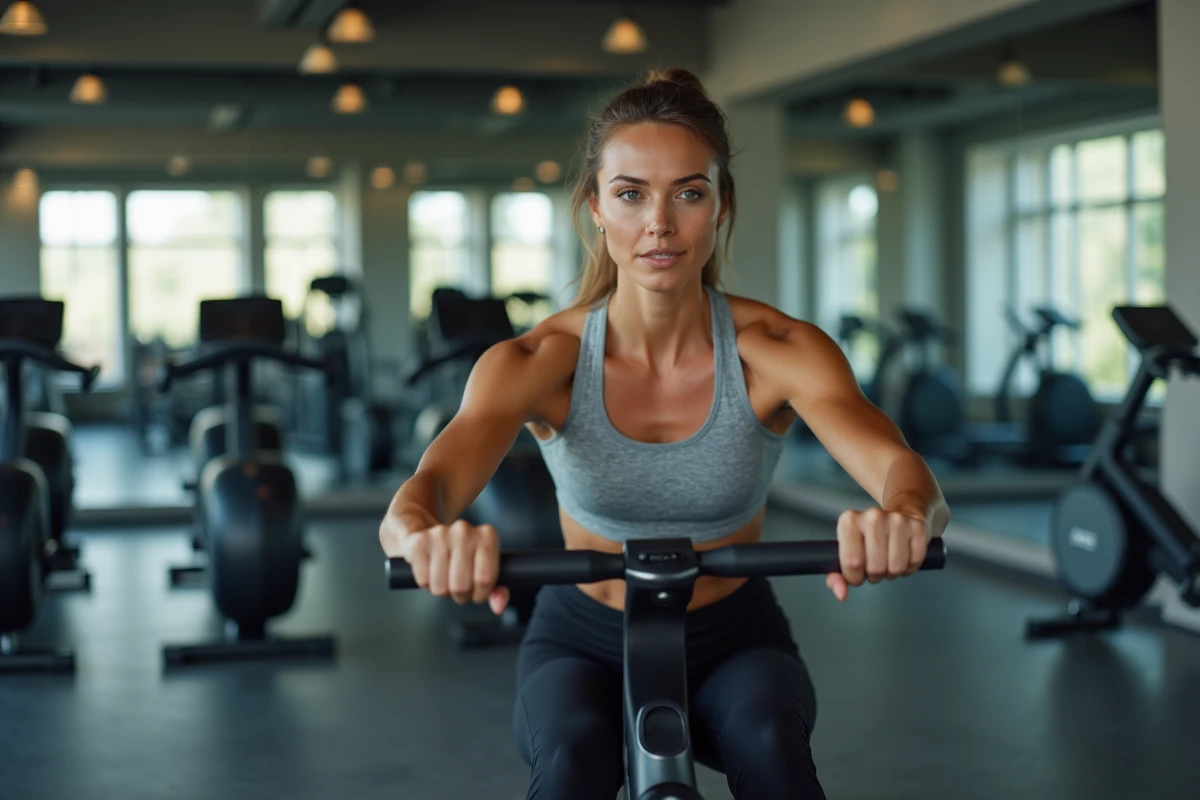
The rowing machine is the machine that recruits the most muscle groups simultaneously: legs, back, arms, and core stabilization. Each rowing stroke engages the abdominal muscles for stabilization, without it being a traditional abdominal exercise. The rowing machine generates a higher caloric expenditure than most other cardio machines for the same perceived level of effort.
In practice, set the resistance to a level that allows you to maintain it for twenty to thirty minutes without technique degradation. The classic trap: pulling only with the arms. Power comes from the push of the legs, then the opening of the torso, and then the pull of the arms. Without this sequence, the back compensates and expenditure drops.
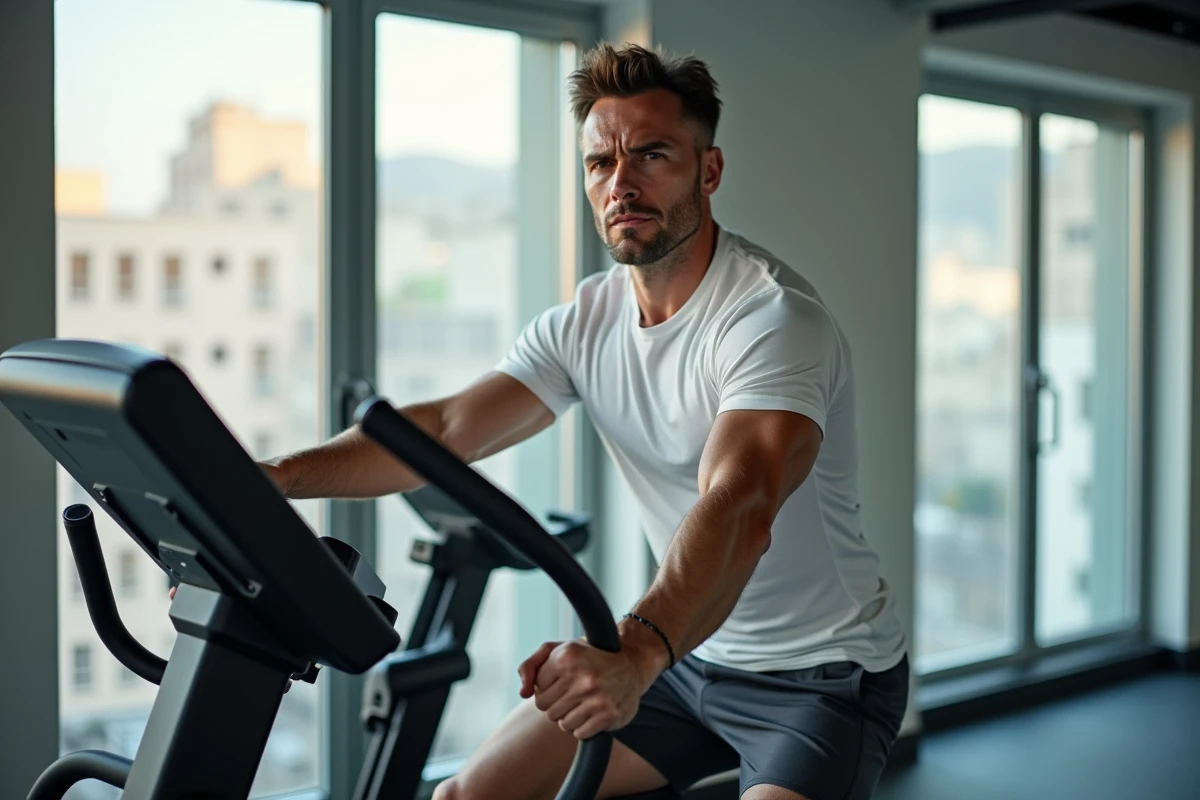
The arm bike (or arm ergometer) remains underutilized in gyms. It forces the upper body to provide the entire effort, which is suitable for individuals with knee or hip joint constraints. Alternating rowing and arm bike throughout the week allows for varied stimuli without overloading the same joints.
HIIT on Treadmill and Elliptical: Concrete Protocols
High-intensity interval training on a treadmill or elliptical shortens session duration while maintaining high caloric expenditure, even after the effort (the “afterburn” effect). Recent recommendations emphasize this format for reducing abdominal fat.
Here is a protocol applicable on treadmill or elliptical:
- Five-minute warm-up at a moderate pace, zero incline or low resistance.
- Eight to ten repetitions of thirty seconds at maximum effort followed by sixty seconds of active recovery (walking or slow pedaling).
- Progressive cool down over five minutes, without abrupt stops.
On the elliptical, the advantage lies in the absence of joint impact. Both arms and legs are engaged simultaneously, which increases total muscle recruitment compared to a standard treadmill. Feedback varies on this point, but most regular users feel more breathless on the elliptical at high resistance than on a flat treadmill.
Heavy Weight Training in the Gym: The Often Overlooked Lever Against Love Handles
Competitors often talk a lot about cardio and bodyweight exercises. We overlook a major lever: progressive weight training with heavy loads profoundly alters body composition. Increasing muscle mass raises the resting metabolism, accelerating fat loss over time.
Three weight machines deserve a place in an anti-love handle program:
- The leg press: it allows for heavy loading safely, without strain on the back. The quadriceps and glutes are the largest muscles in the body, and their intensive recruitment triggers a strong metabolic response.
- The vertical pull (lat pulldown): it develops the latissimus dorsi, improving posture and creating a visual contrast with the waist. A wider back gives the impression of a thinner waist even before fat has decreased.
- The cable station for the pallof press: an anti-rotation exercise that strengthens the obliques and transverse under constant tension, without repeated lumbar flexion.
The goal is three to four weight training sessions per week, increasing the load as soon as you comfortably exceed the target number of repetitions. It’s the progression of the load that triggers adaptation, not repeating the same weight for weeks.
The Invisible Factor: Activity Outside the Gym That Makes the Difference
NEAT (Non-Exercise Activity Thermogenesis) refers to all the calories burned outside of workout sessions: walking, climbing stairs, standing, moving at the office. This parameter has a significant impact on abdominal and subcutaneous fat, sometimes comparable to a moderate increase in time spent on machines when daily movement volume increases consistently.
In practical terms, someone who trains three times a week but sits the rest of the time burns fewer calories than someone who trains twice but actively walks every day. Increasing daily NEAT complements the work done on machines without additional joint fatigue.
The choice of machines in the gym lays the foundation. The rowing machine and elliptical create caloric expenditure, heavy weight training reshapes body composition, and daily movement maintains the deficit. Love handles do not yield to a single device; they recede in the face of a coherent system where each piece plays its role.